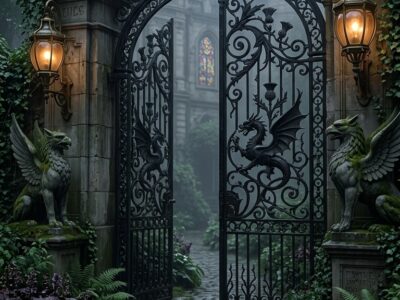
Dark nature aesthetic is not a colour choice. It is a relationship with the part of the natural world that does not perform for you — mud, bark, root systems, rain-wet stone, the underside of leaves.
It borrows from dark forest but goes wider. Forest is a location. Dark nature is a sensibility. It includes moorland, bog, coastal rock, and overgrown garden as readily as deep woodland. The unifying quality is organic darkness — not gothic drama, not horror, just nature rendered without softening.
For digital crafters, scrapbookers, and journalers, dark nature aesthetic translates into specific choices around texture, palette, and motif that are quite different from other dark styles.
Dark nature aesthetic is an earthy, shadowed visual style drawing on raw, unadorned natural elements — bark, lichen, stone, fungi, rain-soaked foliage. Core palette: deep ochre (#7A5C2E), dark moss (#3D4A2A), charcoal (#2C2C28), and iron grey (#5A5850). It appears in journaling, scrapbooking, and POD design, and is distinct from both dark forest (more canopy-focused) and cottagecore (warmer, more pastoral).
What Defines Dark Nature Aesthetic?
Three qualities mark it out from adjacent dark aesthetics.
Texture over pattern. Dark nature is more interested in the surface of things than their outline. Bark texture, stone grain, lichen growth patterns — these read as design elements in their own right. The aesthetic resists clean vector illustration in favour of something that looks touched by weather.
Earthy, not jewel-toned. Where dark forest often pulls toward deep greens and near-black, dark nature stays in the brown-ochre-charcoal range. Think iron, not emerald. The reference is soil and rock, not deep-canopy foliage.
Found objects, not cultivated ones. Cultivated roses belong to dark cottage aesthetics. Dark nature favours fungi, lichen, seed pods, bare branches, feathers, stones with visible mineral veining. Things that arrived without being planted.
The test for dark nature aesthetic: would this thing exist in a garden? If yes, it probably belongs to cottagecore. If it would only exist outside a garden — in a field, on a hillside, in a bog — you are in dark nature territory.
What Is the Dark Nature Colour Palette?
The palette is anchored by four core values. Everything else is derived.
- #7A5C2E — deep ochre. The warm anchor. Appears in clay, dried grasses, bark surfaces, seed pods. The most characteristic colour of this aesthetic — not present in dark forest at all.
- #3D4A2A — dark moss. The green note. Cooler and browner than forest greens. Appears in lichen, wet stone, old wood.
- #2C2C28 — charcoal. The darkest value. Used for ink lines, shadow, silhouettes. Warmer than pure black.
- #5A5850 — iron grey. The neutral mid-tone. Appears in stone, rain, dried botanical stems.
Secondary colours that work within this system: rust (#8B4A2A), ash (#B5B0A8), dried fern (#6B6B3A). Secondary colours that break the aesthetic: anything with cool blue undertones, anything too saturated, pure white.
Ready-to-use digital papers in this palette are available on Creative Fabrica — look for dark botanical and earthy nature ranges. Each file below downloads instantly, opens in Procreate, Photoshop, or Canva, and includes commercial licence for use in products you sell.
Browse Dark Nature Digital Papers →
How Does Dark Nature Aesthetic Work in Journaling and Scrapbooking?
The aesthetic suits journaling well because it tolerates imperfection. A page that is slightly uneven, slightly worn-looking, slightly rough at the edges is more convincing in dark nature style than a clean, precision-assembled spread.
Techniques that work particularly well:
- Texture-first layouts: Start with a dark paper or texture base, then layer botanical elements at varying opacities (30–70%). The depth this creates is the aesthetic’s primary visual quality.
- Asymmetric placement: Dark nature resists symmetry. Place elements slightly off-axis, at unexpected scales. A very large seed pod in one corner and nothing in the other three quarters can work better than four balanced elements.
- Mixed paper weights: In physical journaling, combining different paper types (tissue paper, kraft, watercolour paper) within one spread reinforces the found-object quality of the aesthetic.
- Ink over digital: Adding hand-drawn ink lines over digital paper backgrounds bridges the physical and digital in a way that suits dark nature particularly well.
How to Apply Dark Nature Aesthetic to Wall Art and Home Decor?
The aesthetic carries well into physical spaces because its palette is already neutral enough to sit alongside most interior colours without clashing.
The most effective applications:
- Unframed prints: Washi-tape or clip-hung prints in kraft paper or heavy cream card feel more appropriate than formal framing for this aesthetic. The impermanence suits it.
- Shelf arrangements: Dried botanicals, stone specimens, fragments of bark or lichen alongside books. The key is that objects look collected, not arranged.
- Botanical print clusters: Groups of three to five small prints — seed pod studies, lichen close-ups, branch silhouettes — read better than a single large piece.
For printable wall art in this style: digital botanical illustration packs on Creative Fabrica print well at A4 on uncoated or kraft card. The uncoated surface reinforces the rough-natural quality of the aesthetic. Gloss paper defeats it entirely.
Where to Find Dark Nature Digital Resources?
The challenge with this aesthetic is specificity. “Dark nature” searches surface a lot of photography and art that is too high-contrast, too saturated, or too polished.
Searches that work on Creative Fabrica:
- dark botanical seamless — surfaces the right illustration style
- moody nature paper — good for digital paper packs in the right value range
- earthy botanical clipart — returns the non-floral botanical elements this aesthetic needs
- wild nature pattern — finds the less cultivated, more rugged motif sets
Looking for a moodier direction? Our dark forest aesthetic guide covers the deeper, canopy-focused version of this style. For something in between — soft but still earthy — the ethereal forest aesthetic guide shows the lighter end of the spectrum.
Browse All Dark Nature Resources on Creative Fabrica →
Frequently Asked Questions
What is dark nature aesthetic?
Dark nature aesthetic is a visual style centred on raw, unadorned natural elements — fungi, lichen, bark, stone, seed pods, bare branches — rendered in an earthy palette of ochre, charcoal, dark moss, and iron grey. It is distinct from dark forest aesthetic (which focuses on deep woodland canopy imagery) and from cottagecore (which is warmer and more pastoral).
What colours are used in dark nature aesthetic?
The core palette: deep ochre (#7A5C2E), dark moss (#3D4A2A), charcoal (#2C2C28), and iron grey (#5A5850). Secondary colours include rust, ash, and dried fern tones. The palette avoids cool blue undertones and anything over-saturated — both qualities push it out of dark nature and into other aesthetics.
How is dark nature aesthetic different from dark forest aesthetic?
Dark forest is location-specific — it is about woodland canopy, dense trees, deep greens. Dark nature is broader and more earthy — it includes moorland, bog, coastal stone, and field as well as forest. The palette also differs: dark forest leans green and near-black; dark nature leans ochre and charcoal. Neither is better — they suit different creative projects.
Where can I find dark nature digital papers for journaling?
Creative Fabrica has the best range of dark nature digital papers at commercial licence quality. The most effective search terms: “dark botanical seamless”, “moody nature paper”, “earthy botanical clipart”, “wild nature pattern”. The free plan covers a solid base; the All Access plan opens the full range for exact palette matching.
Can dark nature digital papers be used on POD products?
Yes — most Creative Fabrica digital papers and patterns include a commercial licence covering print-on-demand products. Always confirm with the individual listing’s licence terms. The dark nature palette (ochres, charcoals, dark moss) performs well in fabric and paper print contexts because the earthy neutrals hold colour accuracy across different substrates.
Key Takeaways
- Dark nature aesthetic centres on raw, found-object natural elements — fungi, lichen, bark, stone — rendered in an earthy ochre-charcoal palette, not the deep-green range of dark forest
- The four anchor colours (#7A5C2E, #3D4A2A, #2C2C28, #5A5850) define the system — anything with cool blue undertones or high saturation sits outside the aesthetic
- In journaling, texture-first layering and asymmetric placement work better than balanced, clean spreads — the aesthetic tolerates and rewards visual imperfection
- Digital papers on Creative Fabrica in the dark botanical and earthy nature ranges cover this aesthetic well; print on uncoated card, never gloss