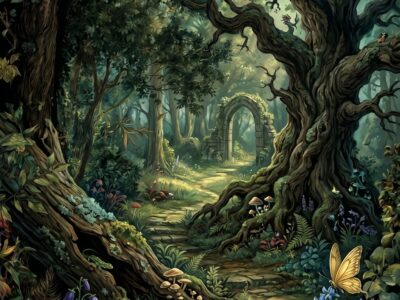
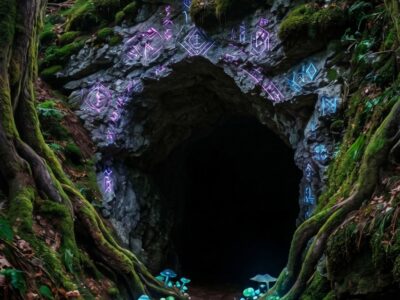
Enchanted forest aesthetic starts where fairy tales leave the path. Not the sanitised kind — the older kind, where the forest has weight and presence and is not entirely safe.
The visual language is built on depth: layered botanical elements, jewel-toned greens, soft purples, and the constant suggestion of something just beyond the frame. It is one of the most versatile dark aesthetics for creative projects because it scales — from a single journal spread to a full wedding or a POD product line.
Enchanted forest aesthetic combines fairy-tale forest imagery with a slightly dark, magical undercurrent — deep teals, soft purples, mossy greens, and gold as an accent. The motif vocabulary includes mushrooms, ferns, fireflies, ancient trees, and magical creatures. It is widely used in journaling, scrapbooking, and home decor, and has a rich range of digital pattern and clipart resources available on Creative Fabrica.
What Makes the Enchanted Forest Aesthetic Distinct?
The defining quality is magic implied rather than stated. Unlike dark forest, enchanted forest does not sit in shadow — it sits in that quality of light just after something has happened, or just before something is about to. The trees are old but not threatening. The colours are deep but not oppressive.
Motif vocabulary that defines the aesthetic: ancient gnarled trees with visible root systems, oversized mushrooms, ferns at all scales, fireflies or will-o’-wisps, moons in different phases, moths, owls, and botanical elements that lean slightly fantastical — more curved, more layered than strict botanical illustration.
What the aesthetic avoids: hyperrealistic photography, clean vector illustration, pastel treatments, and anything that reads as manicured rather than wild. The word “overgrown” is useful here — if it looks deliberately planted, it does not belong.
Enchanted forest aesthetic is the only forest aesthetic where fireflies are a required element. Everything else is optional.
What Is the Enchanted Forest Colour Palette and Key Visual Elements?
The palette is anchored by four values with significant room to shift within each:
- Deep teal (#1B4F5E): The primary cool note. Appears in deep shadow areas, in water reflections, in the underside of leaves. This distinguishes enchanted forest from dark forest (which runs greener) and from mystic forest (which runs more purple).
- Soft purple (#5B4E7E): The magical note. Appears in twilight skies, in flower petals, in the ambient glow around magical elements. Use more sparingly than teal — it is the accent, not the base.
- Moss green (#3A5A3A): The botanical anchor. All foliage, all ground cover, all ferns. This is a mid-value green — not as dark as dark forest, not as pale as ethereal forest.
- Soft gold (#C8A85A): The light source. Fireflies, moonlight on water, highlights on ancient bark, text accents. The warmest colour in an otherwise cool palette.
Texture elements: watercolour washes, soft grain overlays, botanical illustration with slightly fantastical proportions (oversized mushrooms, elongated fern fronds). The textures should feel hand-made — not digital precision, not photographic realism.
Ready-to-download enchanted forest digital papers and patterns are on Creative Fabrica — each file is instant access, commercially licensed, and opens in Procreate, Photoshop, or Canva.
Browse Enchanted Forest Digital Papers →
How to Build Enchanted Forest Journaling Spreads?
The aesthetic suits journaling particularly well because it rewards layering and does not need precise placement. The goal is depth — multiple overlapping elements at different opacities, with the background visible in places.
A reliable approach for a single spread:
- Deep teal or moss green digital paper as the base
- One large tree or fern element at 60–70% opacity in the background
- Two to three smaller botanical clipart elements at full opacity in the foreground
- Soft gold ink or sticker for text elements
- A moon phase or firefly clipart to add the magical note
The most common mistake is using too many elements at full opacity — the spread becomes crowded and loses the hazy depth that defines the aesthetic. Reduce opacity on background elements to 50–60% and the spread settles.
How Does Enchanted Forest Aesthetic Work in Home Decor?
The aesthetic translates well to physical spaces in the same way dark forest does — but with more room for soft purples and blues alongside the greens. The key is that the space should feel like the edge of a forest at dusk, not the interior of one.
Applications that work well:
- Gallery walls: A cluster of botanical prints — oversized ferns, moon phase charts, mushroom studies — in dark frames on a deep wall. The prints should be in the teal-purple-gold range.
- Textiles: Deep teal or forest green linen, cushions with botanical embroidery in soft gold. Avoid bright colours — they break the evening-light quality of the aesthetic.
- Candles and light: Warm candlelight (beeswax or amber LED) on natural surfaces. The quality of light matters — cool white light kills enchanted forest atmosphere entirely.
For printable wall art: enchanted forest pattern sets on Creative Fabrica print well at A3 on matte card. The teal and purple tones are richer in print than on screen — account for this by test printing at A6 before committing to the full size.
What Digital Patterns and Clipart Best Capture Enchanted Forest Style?
The most useful design resources for this aesthetic fall into three categories:
- Seamless pattern sets: Fairytale forest repeats with mushroom, fern, and moon motifs. Look for watercolour style rather than flat vector — the hand-made quality matters for this aesthetic.
- Clipart bundles: Individual transparent-background elements — mushrooms, fireflies, ancient trees, moon phases, owls, moths. These give you the flexibility to build custom compositions.
- Digital paper packs: Background sheets in the teal-purple range with built-in haze or glow effects. The best ones have 8–12 coordinating sheets covering different intensities of the palette.
For the deeper end of this aesthetic, our dark forest aesthetic guide covers resources that push further into shadow. For the lighter, softer end, the ethereal forest aesthetic guide shows the pale, gold-lit version.
Browse All Enchanted Forest Resources on Creative Fabrica →
Frequently Asked Questions
What is enchanted forest aesthetic?
Enchanted forest aesthetic is a fairy-tale-inspired visual style combining deep forest imagery with a magical, slightly dark undercurrent — deep teals, soft purples, moss greens, and warm gold accents. The motif vocabulary includes oversized mushrooms, ancient trees, fireflies, ferns, moon phases, and moths. It is used widely in journaling, scrapbooking, home decor, and digital design.
How is enchanted forest aesthetic different from dark forest aesthetic?
Enchanted forest is lighter in value and more magical in tone. Dark forest prioritises depth and shadow — near-black backgrounds, dense canopy, oppressive scale. Enchanted forest introduces soft purples, glow effects, and fantastical elements (fireflies, oversized mushrooms) that suggest magic rather than threat. The palette in enchanted forest includes more colour range (teal, purple, gold) versus dark forest’s tighter dark-green-to-black range.
What colours define enchanted forest aesthetic?
Deep teal (#1B4F5E), soft purple (#5B4E7E), moss green (#3A5A3A), and soft gold (#C8A85A). The palette is cool-dominant with gold as the single warm accent. Colours to avoid: bright white, pastel anything, cool silver, and any colour with high saturation.
Where can I find enchanted forest digital papers and clipart?
Creative Fabrica has a strong range — use search terms “enchanted forest pattern”, “magical botanical clipart”, “fairy tale digital paper”, and “forest clipart mushroom”. The free plan covers the basics; the All Access plan opens the full range for precise palette matching. Files download instantly and come with commercial licence for product use.
Can enchanted forest aesthetic be used in POD products?
Yes — the aesthetic works well on tote bags, tumblers, throw pillows, notebooks, and phone cases. The teal and purple tones hold colour well in fabric and ceramic printing. Use seamless patterns rather than clipart for surface design applications (the seamless repeat handles scale changes better). Most Creative Fabrica files include POD commercial licence — check the individual listing to confirm.
Key Takeaways
- Enchanted forest aesthetic is defined by magic implied rather than stated — fantastical scale, glow effects, and warm gold light points distinguish it from dark forest’s shadow-and-depth approach
- The four-colour palette (deep teal, soft purple, moss green, soft gold) is the structural anchor; high-saturation colours and cool whites break the aesthetic
- In journaling spreads, reduce background element opacity to 50–60% — crowding is the most common mistake and the easiest to fix
- Enchanted forest digital papers on Creative Fabrica print richer than they appear on screen; test-print at A6 before committing to the full A3 wall art size