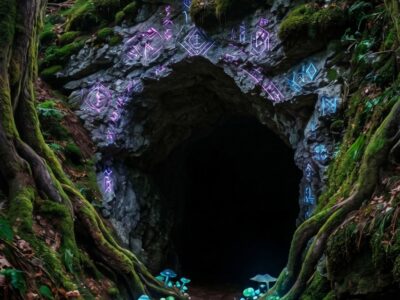
Mystic forest aesthetic exists at the boundary between the natural world and something older. Not enchanted in the fairy-tale sense — mystical in the older sense. The forest knows things. The light here is not daylight.
The visual language combines celestial elements (moons, star maps, constellations) with dense botanical illustration in a palette that runs deep teal, dark purple, near-black, and gold. It is the most layered of the forest aesthetics — several visual systems running simultaneously in a single design.
Mystic forest aesthetic combines deep forest botanical elements with celestial imagery — moon phases, owls, night skies visible through canopy — in a palette of deep teal, dark purple, near-black, and gold. The mood is ancient, atmospheric, and slightly sacred. Creative applications include journaling, scrapbooking, and POD design. The best digital resources are mystic forest seamless pattern sets and enchanted woodland paper bundles on Creative Fabrica.
What Is Mystic Forest Aesthetic?
The key distinction from enchanted forest (fairy-tale, slightly playful) and dark forest (shadow-forward, oppressive) is the celestial layer. Mystic forest always includes the sky — or the suggestion of it. The forest canopy opens onto a moon. A star chart overlays botanical detail. An owl watches from a branch against a night sky backdrop.
The aesthetic has a quality of ancient practice — as though this forest has been observed and charted for a very long time. The botanical elements are specific. The celestial elements are precise. The overall effect is not pretty. It is significant.
Motif vocabulary: ancient trees with visible root systems, owls, moon phases (all phases, not just full moon), mushrooms at significant scale, night-blooming flowers, constellation overlays, ravens, moth wings, and botanical elements that have names — not generic florals.
Mystic forest aesthetic is the only forest aesthetic where the sky and the canopy are equally important. Neither is background. Both are the subject.
What Is the Mystic Forest Colour Palette and Texture Guide?
The palette is the most complex of the forest aesthetics because it has to hold both the deep earth tones of the forest and the cooler celestial tones of night sky.
- Deep teal (#1B4F5E): The primary neutral. Appears in both forest elements (deep water, shadow, ancient bark) and celestial elements (night sky at the horizon, deep space). The bridging colour.
- Dark purple (#3A2A5E): The celestial note. Appears in night sky, in the glow around moons, in shadow areas of botanical elements. More saturated than the other palette colours — used sparingly.
- Near-black (#1A1A18): The background and deep shadow value. Appears as the baseline colour for backgrounds and the deepest shadows in botanical illustration.
- Aged gold (#C8A85A): The light source. Moonlight on bark, stars, highlights on botanical elements, text accents. The single warm colour in an otherwise cool palette — its warmth reads as very specific against the cool background.
Texture: layered. Botanical illustration at one scale, celestial elements at another, texture grain over both. The best mystic forest digital papers have three to four visible layers operating simultaneously — they look complex without being busy.
Ready to use in Procreate, Photoshop, or Canva — each file below is instant download with commercial licence on Creative Fabrica.
Browse Mystic Forest Digital Papers →
What Does a Mystic Forest Mood Board Look Like in Practice?
A mood board for this aesthetic works best when it balances three registers simultaneously:
- Earth register: Bark textures, root systems, dense foliage, mushrooms, ground-level forest detail.
- Sky register: Moon phases, stars, constellation fragments, the quality of light that falls through canopy at night.
- Transition register: The elements that bridge earth and sky — owls in trees, moths ascending, tree canopies silhouetted against night sky, light filtering through branches.
The mood board fails if any one register dominates entirely. Too much earth and it becomes dark forest. Too much sky and it becomes celestial or space aesthetic. The balance is the thing.
What Are Creative Applications for Mystic Forest in Journaling and Scrapbooking?
The most successful applications work with the three-register structure:
- Moon phase trackers: A natural application — the aesthetic already centres on celestial cycles. A spread with a deep teal botanical background, moon phase illustrations across the top, and space for daily tracking below works as both functional journal page and aesthetic piece.
- Observation journals: Night sky, seasonal changes, forest walks. The aesthetic suits a recording function — it feels like documentation rather than decoration.
- Layered scrapbook pages: Base paper in deep teal or near-black, botanical elements at mid-ground, celestial elements at the foreground, aged gold for text and date markers.
For the adjacent lighter aesthetic: the ethereal forest aesthetic guide covers the pale, misty end of the forest aesthetic spectrum. For the adjacent darker version, the dark forest aesthetic guide covers resources for the shadow-dominant direction.
Browse All Mystic Forest Resources on Creative Fabrica →
Frequently Asked Questions
What is mystic forest aesthetic?
Mystic forest aesthetic combines deep forest botanical elements with celestial imagery — moon phases, stars, night sky — in a palette of deep teal, dark purple, near-black, and aged gold. It is distinct from enchanted forest (fairy-tale) and dark forest (shadow-dominant) by its equal weighting of forest and sky elements. The mood is ancient, atmospheric, and slightly sacred.
What colours define mystic forest aesthetic?
Deep teal (#1B4F5E), dark purple (#3A2A5E), near-black (#1A1A18), and aged gold (#C8A85A). The palette bridges forest (earth) and celestial (sky) colour registers, which is the defining challenge of this aesthetic. Avoid bright saturated purples, cool whites, and pastels.
How does mystic forest aesthetic differ from enchanted forest?
Enchanted forest is fairy-tale inflected — oversized mushrooms, fireflies, soft magic. Mystic forest is more ancient and atmospheric — celestial elements, specific botanical precision, owls rather than fireflies. Enchanted forest is lighter in both palette and tone. Mystic forest is darker and more serious in register.
Where to find mystic forest digital patterns and papers?
Creative Fabrica — search “mystic forest pattern”, “enchanted woodland paper”, “celestial botanical seamless”, and “night forest clipart”. The free plan covers the basics; All Access opens the full range. Files are instant download with commercial licence for journaling, POD, and craft use.
Key Takeaways
- Mystic forest aesthetic requires balancing three registers simultaneously — earth (botanicals), sky (celestial), and the transition between them (owls, moths, canopy silhouettes); any single register dominating breaks the aesthetic
- The palette bridges forest and sky: deep teal (#1B4F5E) is the bridging colour that reads as both forest shadow and deep sky
- Moon phase trackers and observation journals are the most natural journaling applications — the aesthetic already centres on celestial cycles and documentation
- The dark purple in this aesthetic must stay in the plum-indigo range (not violet, not bright purple) to remain within the mystic forest palette