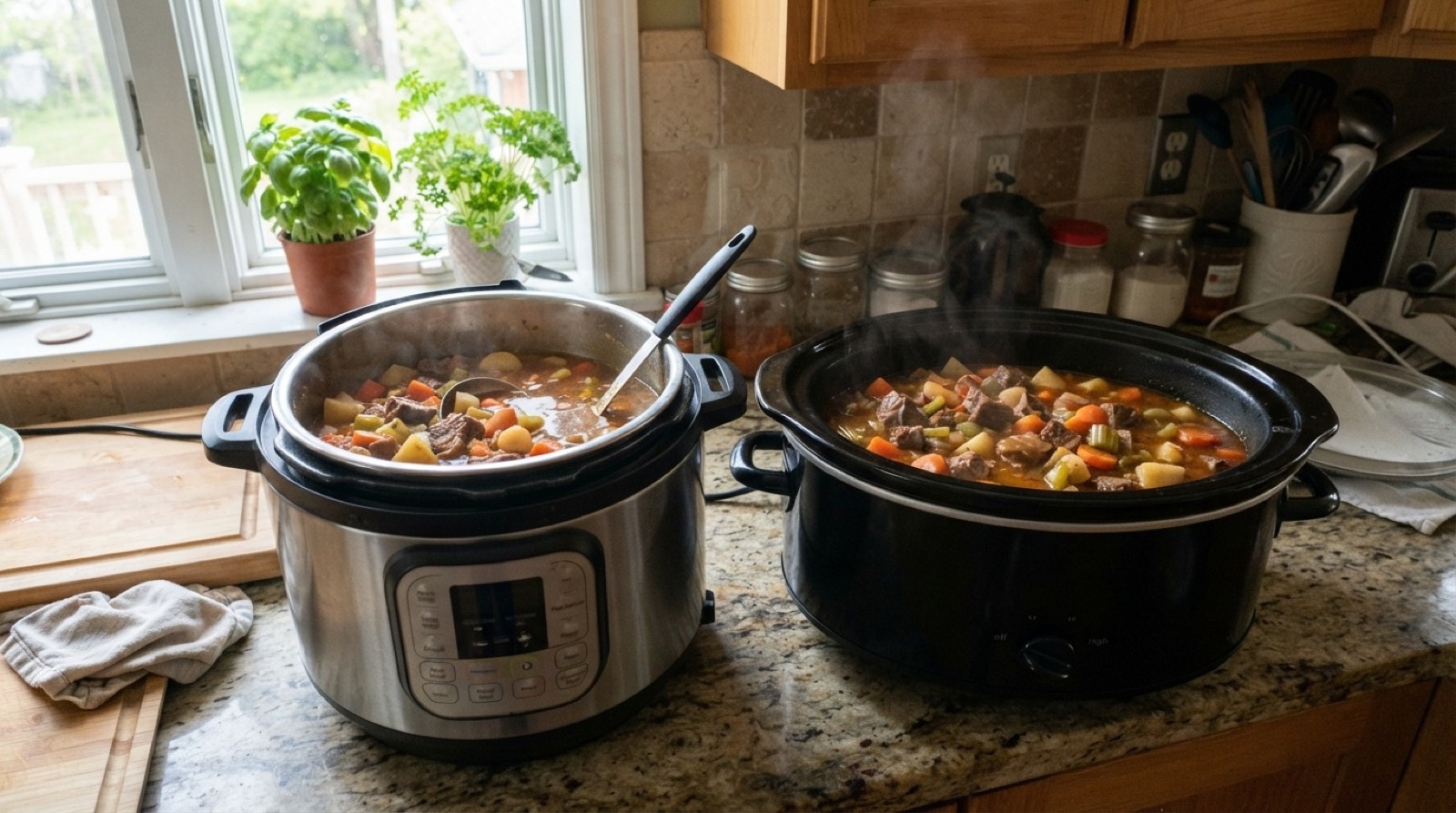
Can you use a crockpot recipe in an Instant Pot, and how do you convert the time? Most recipes are written for one machine, so a slow cooker pot roast says nothing about high pressure, and a pressure cooker chili says nothing about eight hours on LOW. The two disagree about when you need to be in the kitchen, and that, not flavor, is the real basis for choosing.
Below are 5 Instant Pot recipes with the exact pressure minutes, the slow cooker hours they replace, and a full recipe card for each. Each has the one step where a converted recipe usually goes wrong, and a instant-read thermometer settles doneness faster than the clock.
Divide slow cooker hours by twelve for LOW pressure minutes, then add the time to come up to pressure and to release.
Quick answer
Divide by twelve. A dish that takes 8 hours on LOW in a slow cooker takes roughly 40 minutes at high pressure, plus 10 to 15 minutes to come up to pressure and 10 to release. Going the other way, multiply pressure minutes by 12 for LOW and by 6 for HIGH. Cut the liquid by about a third when converting to the slow cooker, and use at least a cup when converting to pressure.
What are Instant Pot recipes?
Instant Pot recipes are dinners cooked in an electric multi-cooker that seals the lid, traps steam and raises the boiling point from 212°F to around 250°F at 15 psi. Food cooks about twice as fast for every 20°F above 212°F, which is most of the difference between 8 hours and 40 minutes.
The same cheap cuts and pantry staples work in both machines, so the recipes below are the ones that convert cleanly either way. For the slow side, see crockpot pot roast and crockpot soup recipes, both of which list LOW and HIGH times you can run through the conversion.
Pick the right Instant Pot recipe in one minute
| Preview | Idea | Best for | Hands-on time | Avoid if | Get it |
|---|---|---|---|---|---|
 | 1. Instant Pot Pot Roast | Sunday dinner in an hour | Medium · 70 min | You want long, soft strands | Jump to recipe |
 | 2. Slow Cooker Beef Stew, Converted From an Instant Pot Recipe | A worked conversion | Medium · 7 h | You are short on time | Jump to recipe |
 | 3. Instant Pot Bone Broth | Soup and sipping | Low · 2 h | You need it in 30 minutes | Jump to recipe |
 | 4. Instant Pot White Rice | A side in 15 minutes | Low · 15 min | You cook for a crowd of 12 | Jump to recipe |
 | 5. Instant Pot Dried Beans, No Soak | Chili and meal prep | Low · 55 min | You only own canned beans | Jump to recipe |
Every recipe fits a 6-quart Instant Pot, and the times in the cards are minutes at high pressure with a natural release unless noted. The bigger the piece, the longer the come-up, but the minutes at pressure do not change.
For a first try, make the white rice (4). It takes three minutes at pressure and teaches you the sealing valve and the natural release. For a whole dinner that survives either machine, see casserole recipes for dinner and healthy crockpot recipes.
How do you convert between a slow cooker and an Instant Pot?
- Slow cooker LOW to Instant Pot: divide the hours by twelve. 4 hours becomes 20 minutes, 8 hours becomes 40 minutes, 10 hours becomes 50 minutes.
- Slow cooker HIGH to Instant Pot: divide the hours by six. 2 hours becomes 20 minutes, 4 hours becomes 40 minutes.
- Instant Pot to slow cooker: multiply the minutes by twelve for LOW or by six for HIGH. A 35-minute pressure recipe becomes about 7 hours on LOW.
- Liquid: a pressure cooker needs at least a cup of thin liquid to seal, and a slow cooker loses almost none, so cut liquid by about a third going to the slow cooker.
- Real time: add 10 to 15 minutes at the front for the pot to come up to pressure and about 10 at the back for a natural release. A 40-minute recipe is an hour at the counter, still a fraction of eight. A thermometer check confirms the finish.
The Base Method for Pressure Cooking
Liquid first
Pour in at least a cup of thin liquid, water, stock or a thinned sauce, before anything else. Thick tomato sauces go on top of the other ingredients without stirring, or they sit on the base, scorch and trip the burn warning.
Brown before sealing
Browning does the same job in either machine, and skipping it costs the same depth. A heavy skillet browns faster than the pot’s own sauté function, and the browned bits dissolve into the liquid.
Vegetables go in last
Carrots and potatoes that are perfect after 8 hours on LOW turn to pulp in 40 minutes at pressure. Cut them larger, or add them for a second short pressure cycle after the meat is done. The same clash shows up in crockpot soup recipes, where the fix is the same.
Natural release for meat, quick release for vegetables
Quick release stops the cook instantly, which suits delicate vegetables. Natural release lets the pot depressurize over 10 to 20 minutes and keeps the food cooking gently, which is why tougher cuts almost always call for it.
Check the center, not the clock
The shred point for beef is 195 to 205°F, the one number that transfers between the machines unchanged. Push a instant-read thermometer into the thickest part before you decide it needs more time.
1. Instant Pot Pot Roast
Instant Pot pot roast is the recipe that shows the conversion best: a 3-pound chuck roast takes 60 to 70 minutes at high pressure with a natural release, against 8 hours on LOW in a slow cooker. That is roughly the same twelve to one ratio as the beef stew below.
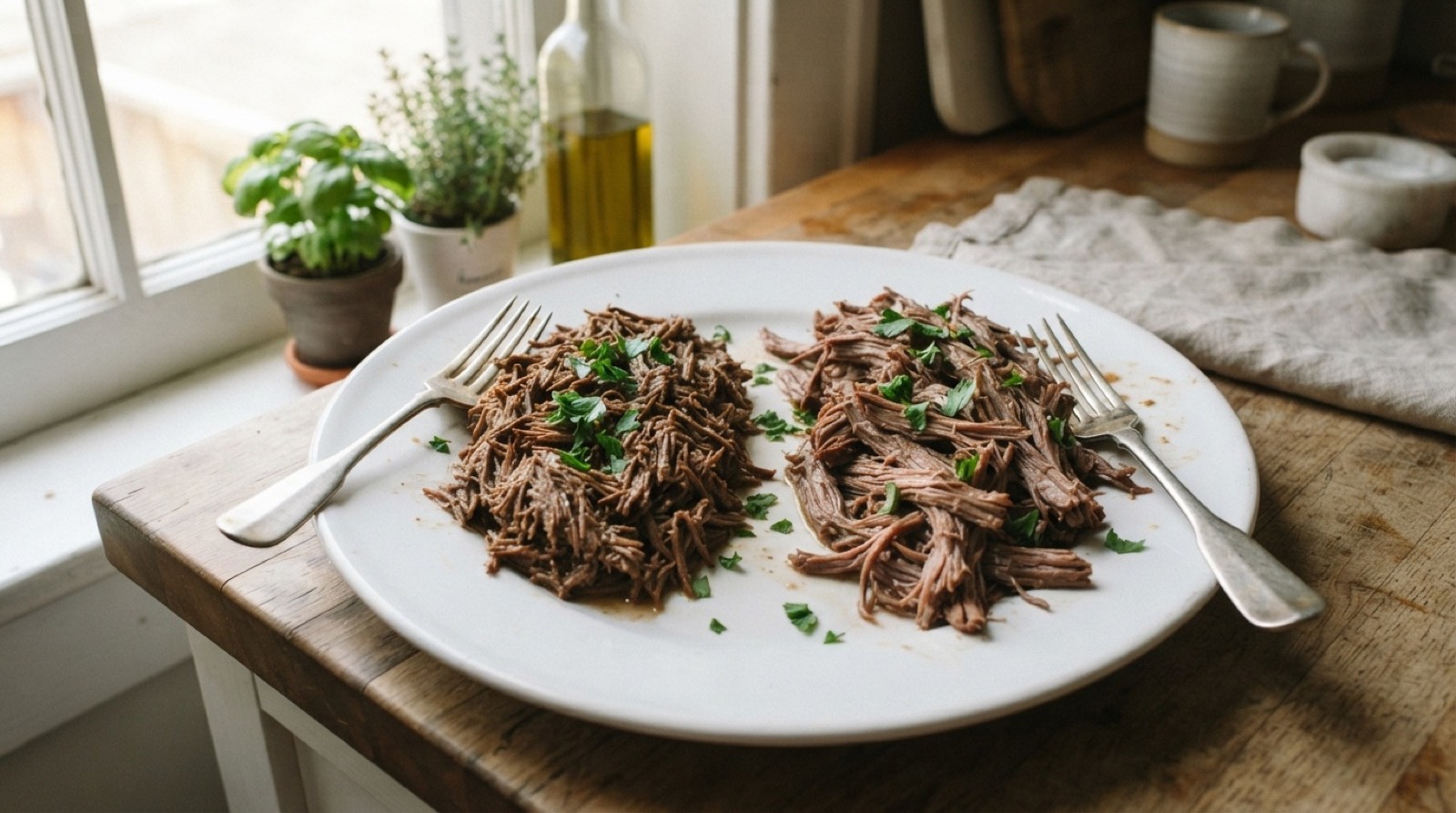
The roast comes out tender and juicy, with a gravy built from the browned bits. Pressure pulls the meat apart into shorter, wetter shreds than eight hours on LOW, which gives longer strands that hold their shape when you lift them.
The catch is the vegetables, which go mushy if they cook the whole hour. Add the carrots and potatoes in large chunks after a 45-minute roast, then seal for 10 more minutes. See crockpot pot roast for the slow version, and check the finish with a instant-read thermometer.
Instant Pot Pot Roast
Course: Main CourseDifficulty: Easy6
servings15
minutes1
hour15
minutesA 3-pound chuck roast browned, pressure cooked for about an hour with a natural release, then finished with carrots, potatoes and a quick gravy.
Ingredients
3 lb boneless chuck roast, cut in 2 or 3 pieces
1 1/2 tsp kosher salt
1/2 tsp black pepper
2 tbsp olive oil
1 yellow onion, sliced
4 garlic cloves, minced
1 tbsp tomato paste
1 cup beef broth
2 tbsp Worcestershire sauce
1 tsp dried thyme
1 bay leaf
1 lb carrots, cut in large chunks
1 1/2 lb baby potatoes, halved
2 tbsp cornstarch mixed with 2 tbsp cold water
Directions
- Season the roast with the salt and pepper on all sides.
- Heat the oil on the sauté setting and brown the roast 3 to 4 minutes per side. Move it to a plate.
- Cook the onion in the same pot for 3 minutes, then add the garlic and tomato paste for 1 minute.
- Pour in the broth and Worcestershire and scrape up every browned bit from the bottom so the pot does not trigger the burn warning.
- Add the thyme and bay leaf, set the roast on top and seal the lid with the valve on Sealing.
- Pressure cook on high for 45 minutes, then let the pressure release naturally for 15 minutes.
- Open the lid, add the carrots and potatoes around the roast and seal again.
- Pressure cook on high for 8 minutes and quick release.
- Lift the roast and vegetables out. Stir the cornstarch slurry into the liquid on sauté until the gravy thickens.
- Check the roast with a thermometer. It should read 195 to 205°F in the thickest part. Slice or shred and serve with the gravy.
Notes
- Chuck roast is the cut that gets tender at pressure; lean roasts such as round dry out. Do not fill the pot past the two-thirds line. Leftovers keep 3 to 4 days and freeze well in their gravy.
2. Slow Cooker Beef Stew, Converted From an Instant Pot Recipe
A 35-minute pressure cooker beef stew becomes a 7-hour slow cooker dinner: same beef, potatoes and carrots, less liquid, and a cornflour slurry stirred in at the end. It is the worked example for the whole conversion.
The math is three steps. Multiply 35 minutes by 12 to get about 7 hours on LOW, cut the 2 cups of stock to about 1 1/3 cups because nothing boils away, and leave the vegetables in from the start because they need the hours here, unlike at pressure.
The catch is a thin sauce, because the pressure version thickens on sauté and the slow version cannot. Stir in the cornflour slurry for the last 30 minutes on HIGH. A dedicated slow cooker with wrap-around heat does this job better than the Instant Pot’s own slow cook button.
Slow Cooker Beef Stew, Converted From an Instant Pot Recipe
Course: Main CourseDifficulty: Easy6
servings15
minutes7
hours30
minutesA 35-minute pressure-cooker beef stew becomes a 7-hour slow cooker dinner: same beef, potatoes and carrots, less liquid, and a cornflour slurry stirred in for the last half hour.
Ingredients
2 lb beef stew meat, cut in 1 1/2 inch cubes
1 1/2 tsp kosher salt
1/2 tsp black pepper
2 tbsp olive oil
1 yellow onion, chopped
3 garlic cloves, minced
1 tbsp tomato paste
1 1/3 cups beef stock
1 tbsp Worcestershire sauce
1 tsp dried thyme
1 bay leaf
1 1/2 lb potatoes, cut large
1 lb carrots, cut large
2 tbsp cornflour mixed with 2 tbsp cold water
Directions
- Season the beef with the salt and pepper.
- Brown the beef in the oil in batches in a skillet, 2 to 3 minutes per side, the same way the pressure cooker recipe called for.
- Add the onion, garlic and tomato paste to the skillet for 2 minutes.
- Put the beef, onion mixture, potatoes and carrots into a 6-quart slow cooker from the start. The vegetables need the full cook time here.
- Pour the stock and Worcestershire around the beef and add the thyme and bay leaf.
- Cover and cook on LOW for about 7 hours (35 pressure minutes times 12), without lifting the lid.
- In the last 30 to 60 minutes, switch to HIGH.
- Stir in the cornflour slurry and cook with the lid on until the sauce thickens.
- Check a piece of beef with a thermometer. It should be fork-tender.
- Remove the bay leaf, taste for salt and serve.
Notes
- Converting any pressure cooker recipe the same way: divide the minutes by twelve for LOW, cut the liquid by about a third, and add vegetables from the start instead of partway through. Leftovers keep 3 to 4 days.
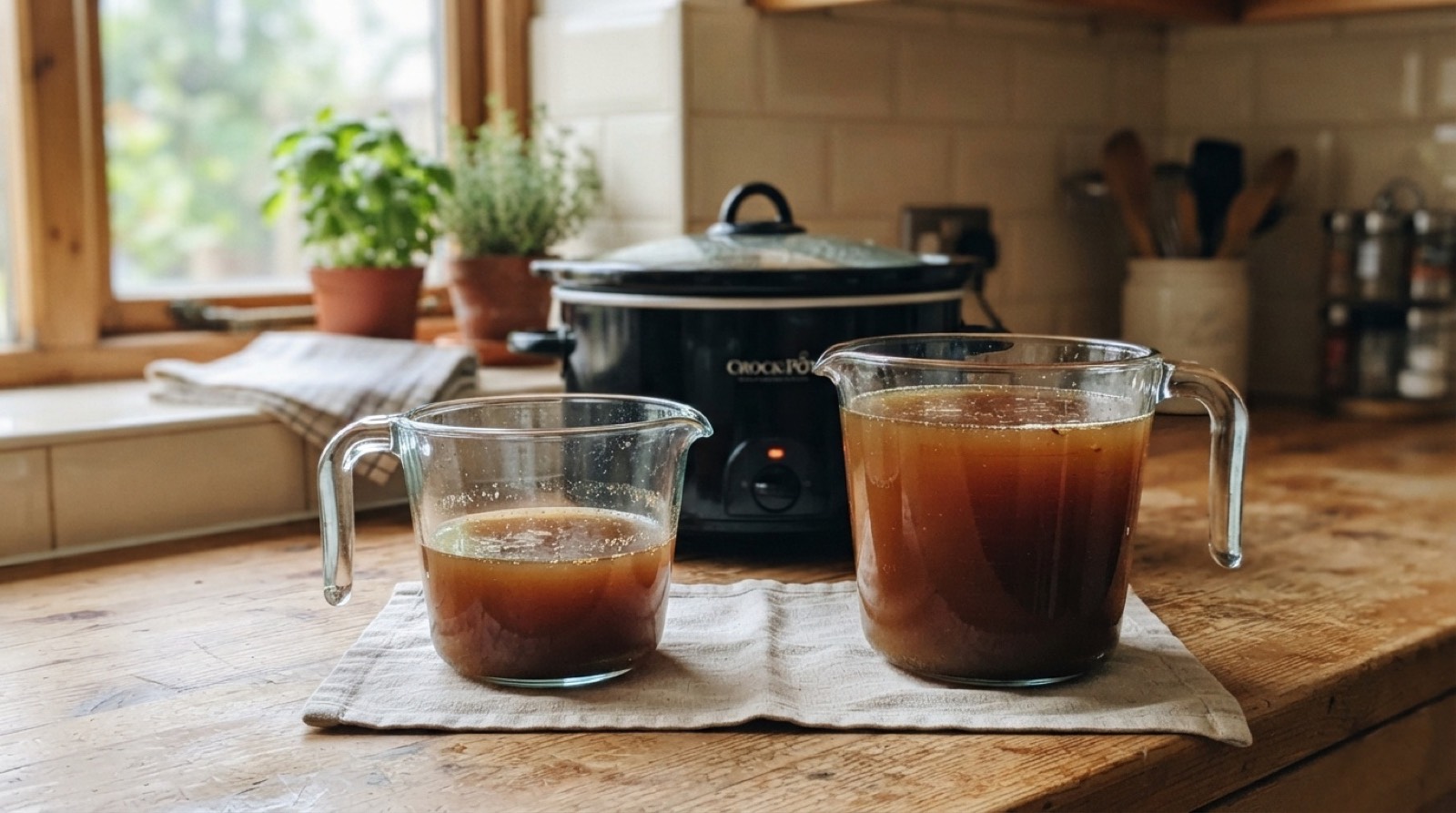
3. Instant Pot Bone Broth
Instant Pot bone broth runs 2 hours at high pressure with a natural release, versus 24 hours on LOW in a 7-quart slow cooker. The pressure version pulls out nearly as much collagen, because the higher temperature does in 2 hours what a low simmer needs a full day to reach.
The broth is rich and gels in the fridge, which is the sign the collagen came out. It suits soups, sipping from a mug, and any recipe that calls for stock.
The catch is the float valve. Do not fill the pot past the two-thirds line, and use the natural release, because quick-releasing a pot of mostly liquid can spit hot broth through the vent. Crack the valve in short bursts if you must.
Instant Pot Bone Broth
Course: Main CourseDifficulty: Easy8
servings15
minutes2
hours15
minutesRoasted beef or chicken bones and aromatics pressure cooked for 2 hours with a natural release into a rich, gelling broth.
Ingredients
3 lb beef or chicken bones
1 yellow onion, quartered
2 carrots, cut in chunks
2 celery stalks, cut in chunks
4 garlic cloves, smashed
2 tbsp apple cider vinegar
2 bay leaves
1 tsp whole peppercorns
1 tsp kosher salt
1 small bunch parsley stems
8 cups cold water, to the fill line
Directions
- Roast the bones on a sheet pan at 425°F for 30 minutes for deeper flavor.
- Put the bones in the pot with the onion, carrots, celery, garlic, bay leaves, peppercorns and parsley stems.
- Add the vinegar and enough cold water to reach the two-thirds fill line, no higher.
- Seal the lid with the valve on Sealing.
- Pressure cook on high for 120 minutes.
- Let the pressure release naturally for at least 20 minutes.
- Open the lid and lift out the bones and vegetables with a strainer.
- Strain the broth through a fine-mesh sieve into a large bowl.
- Stir in the salt and taste.
- Chill until the fat lifts off in a layer, then store the broth in jars.
Notes
- Bones from a roast carcass work as well as raw ones. The broth keeps 4 to 5 days in the fridge and 4 to 6 months in the freezer. Leave 1 inch of space in jars before freezing.
4. Instant Pot White Rice
Instant Pot white rice is the one recipe where the pressure cooker beats the slow cooker by a mile: 3 minutes at high pressure with a 10-minute natural release, and no stirring. A slow cooker handles rice badly, which is why no conversion transfers it.
The rice comes out fluffy and separate, with a 1 to 1 ratio of rice to water. Rinse it until the water runs clear, or it turns gluey.
The catch is the ratio. More water than 1 to 1 makes mush, and less trips the burn warning on the base. Measure by volume, not by eye, and do not stir after sealing. A 7-quart slow cooker cannot do this job, which is why rice stays on the pressure side.
Instant Pot White Rice
Course: Main CourseDifficulty: Easy4
servings5
minutes18
minutesRinsed long-grain white rice at a 1 to 1 ratio, 3 minutes at high pressure and a 10-minute natural release for fluffy, separate grains.
Ingredients
1 1/2 cups long-grain white rice
1 1/2 cups water
1/2 tsp kosher salt
1 tbsp butter
1 tsp olive oil, optional
1 bay leaf, optional
1/2 tsp garlic powder, optional
2 tbsp chopped chives, for serving
1/4 tsp black pepper
1 lemon wedge, optional
Directions
- Rinse the rice in a fine-mesh sieve until the water runs clear.
- Drain the rice well and put it in the inner pot.
- Add the water, salt and olive oil and give it one stir.
- Scrape down any grains stuck on the sides.
- Seal the lid with the valve on Sealing.
- Pressure cook on high for 3 minutes.
- Let the pressure release naturally for 10 minutes, then quick release the rest.
- Open the lid, add the butter and fluff with a fork.
- Taste and add pepper and chives.
Notes
- The 1 to 1 ratio is for long-grain white rice. Brown rice needs about 1 1/4 cups of water per cup and 22 minutes. Do not use sticky rice varieties with this ratio. Leftover rice keeps 3 to 4 days in the fridge.
5. Instant Pot Dried Beans, No Soak
Instant Pot dried beans cook with no soak in under an hour, which a slow cooker cannot match. Pinto, black and kidney beans all work, and the pot does in 45 minutes what a soak plus a simmer does in a day.
The beans are creamy inside with intact skins. They suit chili, burritos and meal prep, and a batch covers a week of dinners.
The catch is foam. Beans foam under pressure and can clog the vent, so add a tablespoon of oil and never fill past half the pot. Dishes like crockpot chili take the cooked beans straight from the pot.
Instant Pot Dried Beans, No Soak
Course: Main CourseDifficulty: Easy8
servings5
minutes1
hour5
minutesUnsoaked dried pinto beans pressure cooked for 45 minutes with a natural release for creamy beans ready for chili or burritos.
Ingredients
1 lb dried pinto beans, rinsed and sorted
6 cups water
1 tbsp olive oil, to cut the foam
1 yellow onion, halved
4 garlic cloves, peeled
2 bay leaves
1 tsp ground cumin
1 tsp kosher salt
1/2 tsp black pepper
1 tsp smoked paprika
Directions
- Sort the beans and rinse them under cold water.
- Put the beans in the inner pot with the water and oil.
- Add the onion, garlic, bay leaves, cumin and paprika.
- Do not fill the pot more than halfway, because beans expand and foam.
- Seal the lid with the valve on Sealing.
- Pressure cook on high for 45 minutes.
- Let the pressure release naturally for at least 20 minutes.
- Open the lid, remove the onion and bay leaves and stir in the salt and pepper.
- Taste a bean for tenderness. Cook 5 more minutes at pressure if it is still firm.
- Drain and use, or store the beans in their liquid.
Notes
- Salt goes in after cooking so the skins soften. Older beans take longer. Beans keep 5 days in the fridge in their liquid and freeze well for 6 months. Use them like canned beans, about 1 1/2 cups per can.
If It Goes Wrong: Burn Warning, Mushy, Thin
- The pot says burn on a converted recipe: slow cooker recipes are written for very little liquid, and thick tomato sauces sit on the base and scorch under pressure. Add a cup of stock or water, and layer thick sauce on top of the other ingredients without stirring it in.
- Vegetables turned to pulp: they cooked past done while the meat was still catching up. Cut them larger or add them for a second short cycle.
- The sauce is thin: neither machine reduces with the lid on. The Instant Pot has sauté, which does it in five minutes at the end. A slow cooker needs the lid off on HIGH for 30 to 45 minutes, and a pot whose insert is safe on the hob can reduce on a burner.
- The pot will not seal: there is not enough thin liquid, or the sealing ring is out of place. Use at least a cup, and check the ring and the valve.
Slow Cook Button, Batch Size, Safety and Cleanup
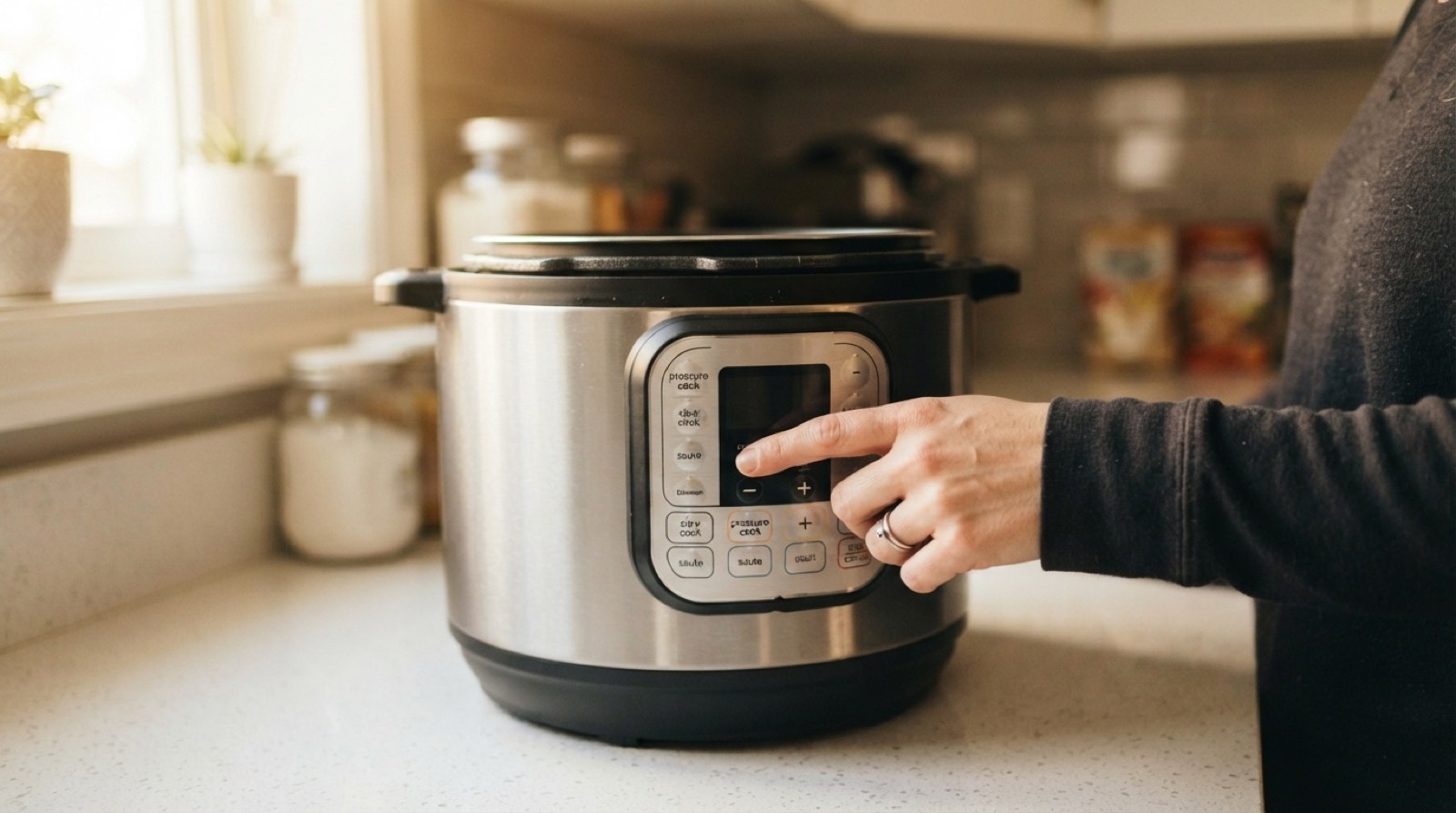
The slow cook mode on a multi-cooker is not a true equivalent. The heating element sits under the base rather than wrapping the walls, so it runs cooler than a dedicated pot: use the highest level and add up to an hour.
If slow cooking is your normal weekday method, a dedicated slow cooker is the better tool. If it is an occasional fallback, the button is fine as long as you expect to add time.
Pressure time depends on the thickness of the food, not the quantity, so doubling a recipe does not change the minutes at pressure, only the come-up. Never fill past the two-thirds line, and half for beans and rice.
Every electric multi-cooker that reads pressure in psi, Ninja Foodi included, uses the same conversion math. For a stovetop pot with no pressure, multiply the minutes by 12 to 15 for a low simmer.
A slow cooker lifted mid-cook costs time, not safety. The pressure cooker locks the lid until the pressure drops, and electric models add a float-valve lock.
The sealing ring absorbs odors from strong food, so own a second one if you cook both curry and yogurt. The float valve needs a rinse after a vigorous release.
Most stews, chilis and shredded-meat dinners freeze well after pressure cooking, if cooled completely first. See freezer meals for what holds up through a freeze-thaw cycle.
For whole potatoes, crockpot potatoes gives the slow timing, 4 hours on HIGH, against 12 to 15 minutes at pressure.
 Pin it
 Pin it

Key takeaways
- Divide slow cooker hours by twelve for LOW and by six for HIGH to get pressure minutes.
- Add 10 to 15 minutes to come up to pressure and about 10 for the release.
- Use at least a cup of thin liquid at pressure, and a third less in the slow cooker.
- Add vegetables late at pressure and early in the slow cooker.
- Rice, beans and potatoes belong to the Instant Pot, long shreds to the slow cooker.
- Check the center with a thermometer instead of trusting the clock.
When the free version isn’t enough
The conversion only gets you to the right neighborhood, and a instant-read thermometer or a quick temperature check takes the guess out. Households that keep both machines usually reach for a 7-quart slow cooker for the morning case, because its wrap-around heat is what the button cannot fully copy. If you are short on a roast pan, a heavy skillet browns for either pot.
Start with something forgiving both ways. Crockpot chicken recipes, crockpot chili and crockpot meatballs list LOW and HIGH times that plug straight into the divide-by-twelve rule. Cheap dinners for a family lists several beginner dinners, crockpot pork chops shows a cut that goes the other way at pressure, and the pasta and rice rules that no conversion transfers are in crockpot pasta recipes.
Common questions
Can I use a crockpot recipe in an Instant Pot, and how do you convert it?
Yes. Divide the LOW time by twelve for high-pressure minutes, make sure there is at least a cup of thin liquid, and cut vegetables larger. Expect the meat to shred shorter and wetter. To make Instant Pot recipes in a crock pot, multiply the minutes by twelve for LOW or six for HIGH.
Is an Instant Pot better than a slow cooker, and which is cheaper to run?
Neither is better. The Instant Pot turns a long cook into an hour when you are home, and the slow cooker cooks while you are not. The pressure cooker draws power for under an hour instead of eight, so it is cheaper to run, but on a single dinner the difference is small.
Does the slow cook function on an Instant Pot work?
It works, but it runs cooler than a dedicated slow cooker because the heat comes from the base rather than the walls. Use the highest level and add up to an hour to the recipe.
Why does my Instant Pot say burn on a converted recipe, and how much liquid does it need?
Thick tomato-based sauces sit on the base and scorch under pressure. Add a cup of stock or water, and layer thick sauce on top without stirring. An Instant Pot needs at least a cup of thin liquid to seal, regardless of recipe size.
Can you cook a roast in an Instant Pot, and how long does it take?
Yes. A 3-pound chuck roast takes about 60 to 70 minutes at high pressure with a natural release, against 8 hours on LOW, roughly the same twelve to one ratio. Brown it first in either machine or on the stove.
How long to pressure cook potatoes in an Instant Pot?
12 to 15 minutes at high pressure for whole medium potatoes on a trivet with a cup of water, skin on. Cubed potatoes need only 4 to 5 minutes or they turn to mash.
How do you double, halve or cut Instant Pot recipes in half, and what is the manual setting?
Pressure time depends on thickness, not quantity, so keep the minutes and change the ingredients. The Manual or Pressure Cook setting lets you set the minutes yourself, and the flavor buttons are shortcuts to the same program.
What are the best Instant Pot recipes for beginners, and can they be made ahead and frozen?
Start with chicken thighs, chili, pot roast or rice, which forgive a few extra minutes. Most stews, chilis and shredded-meat dinners freeze well after pressure cooking if cooled completely first.